Background
In my time as a Content Designer at Meta, I led strategy for how users discover and learn how to use features across the Meta Wearables ecosystem. Rather than designing a single onboarding experience, I reframed feature education as a continuous system spanning the user lifecycle. This work focused on:
• Discovery frameworks
• Lifecycle education
• Information architecture
• Cross-functional alignment
• Experience strategy
Role: Led strategy, information architecture, and content design for discovery and education across Meta Wearables.
Partners: Product Design, PM, UX Research, Engineering, Marketing, Data Science
The challenge
Meta wearables continually gain new capabilities, but users weren’t discovering and using them, not because they’re difficult to understand or use, but they weren’t presented in the right way and at the right time.
Key context:
Wearables are a novel form factor
AI capabilities evolve constantly
Traditional onboarding techniques don’t scale
Education can quickly get stale as features evolve

My role
Responsibilities
Led strategy for discovery and education
Facilitated workshops across Product, Design, Research and PM
Developed reusable frameworks
Defined IA principles
Designed education patterns
Partnered on experimentation strategy
What wasn’t working
Through partner interviews, research synthesis, and audits of existing education surfaces, I identified a pattern: we were optimizing for individual moments rather than designing a system.
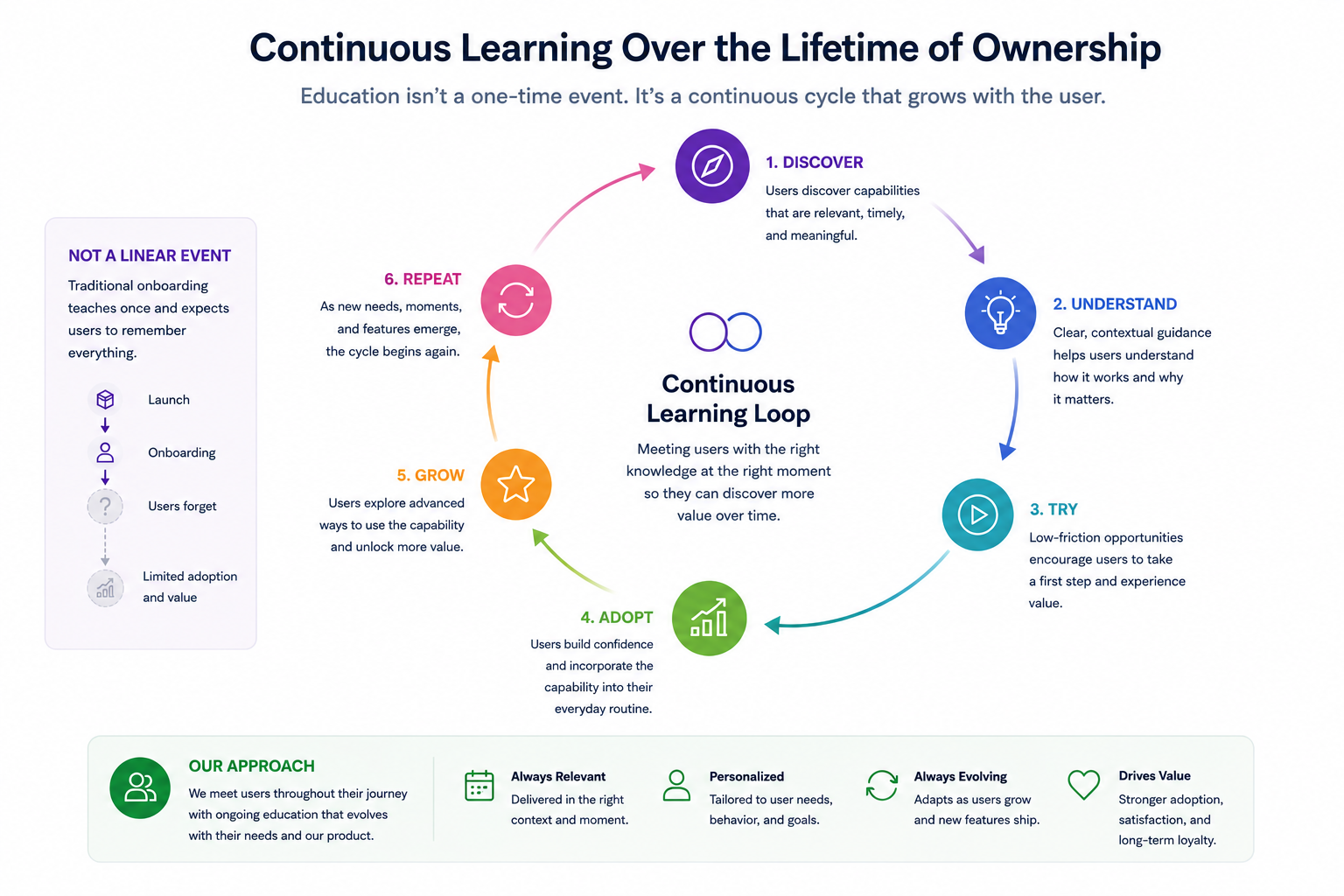
Reframing the problem:
Instead of focusing on how we could improve onboarding, I considered how people could continuously learn and evolve with a product.
By personalizing education and meeting users where they are in their journey, Meta could build trust and gain the attention needed for users to understand the value the features have in their daily lives.
A new framework
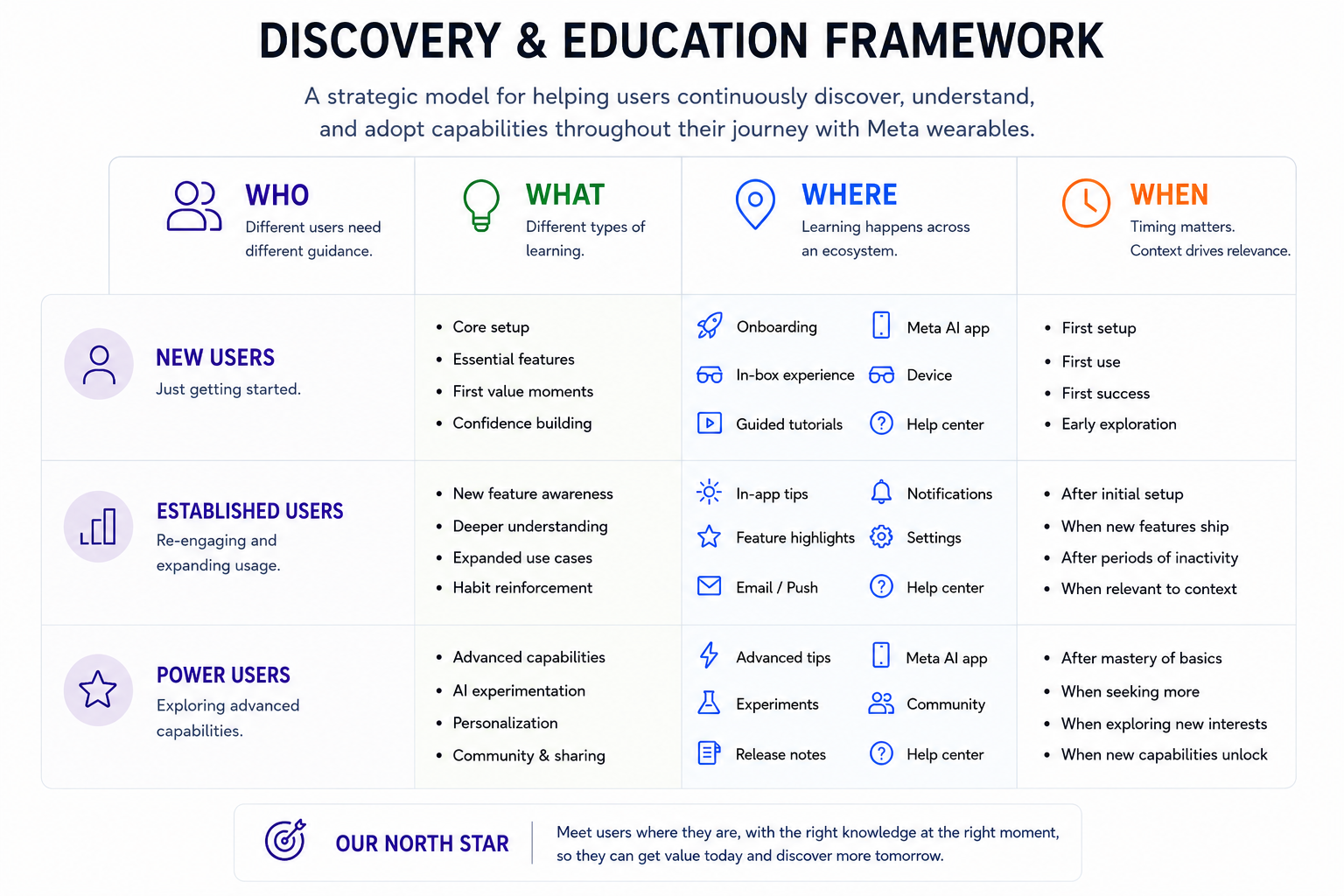
A one-size-fits-all approach doesn’t work in formal education, so why should we expect it to work in real life?
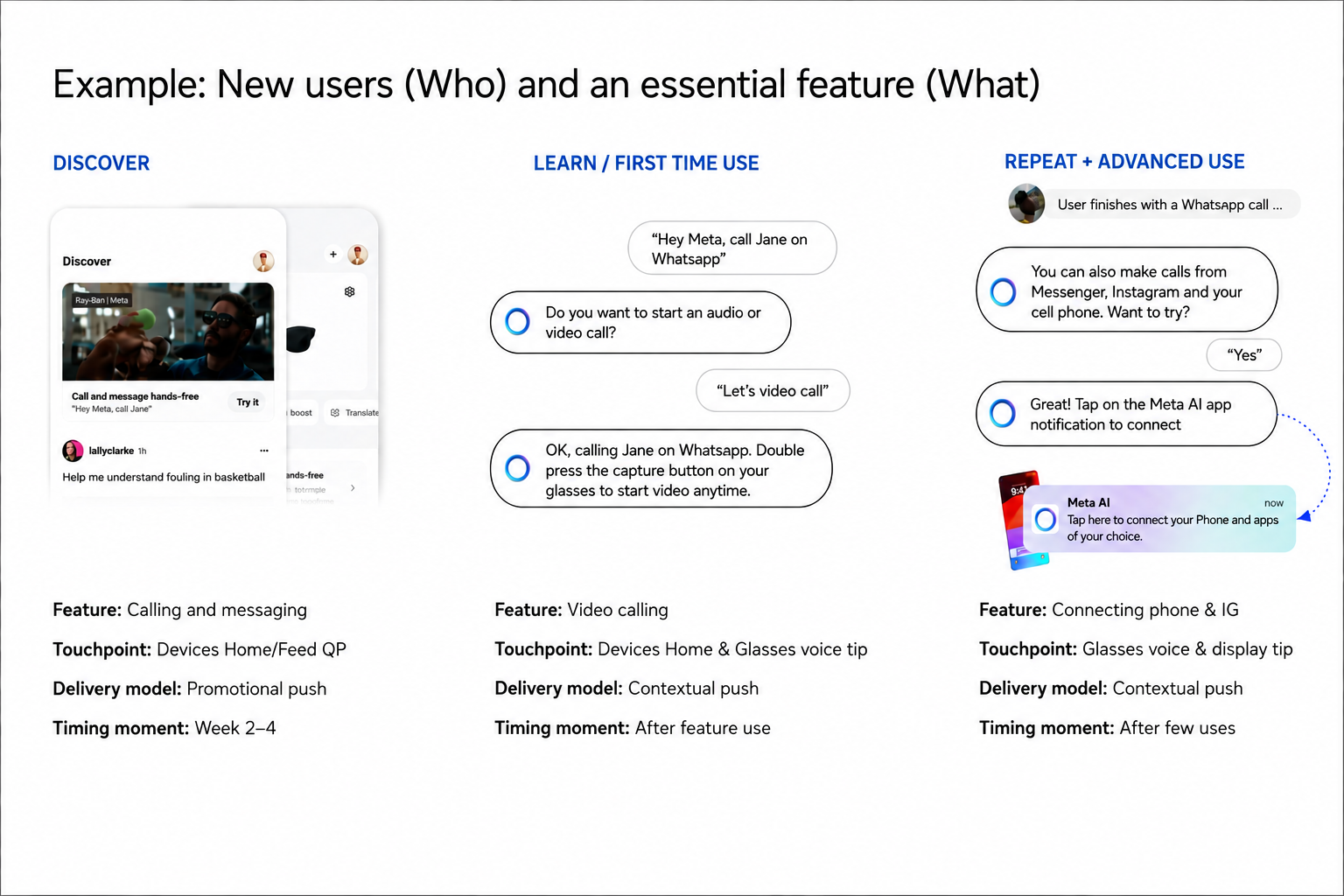
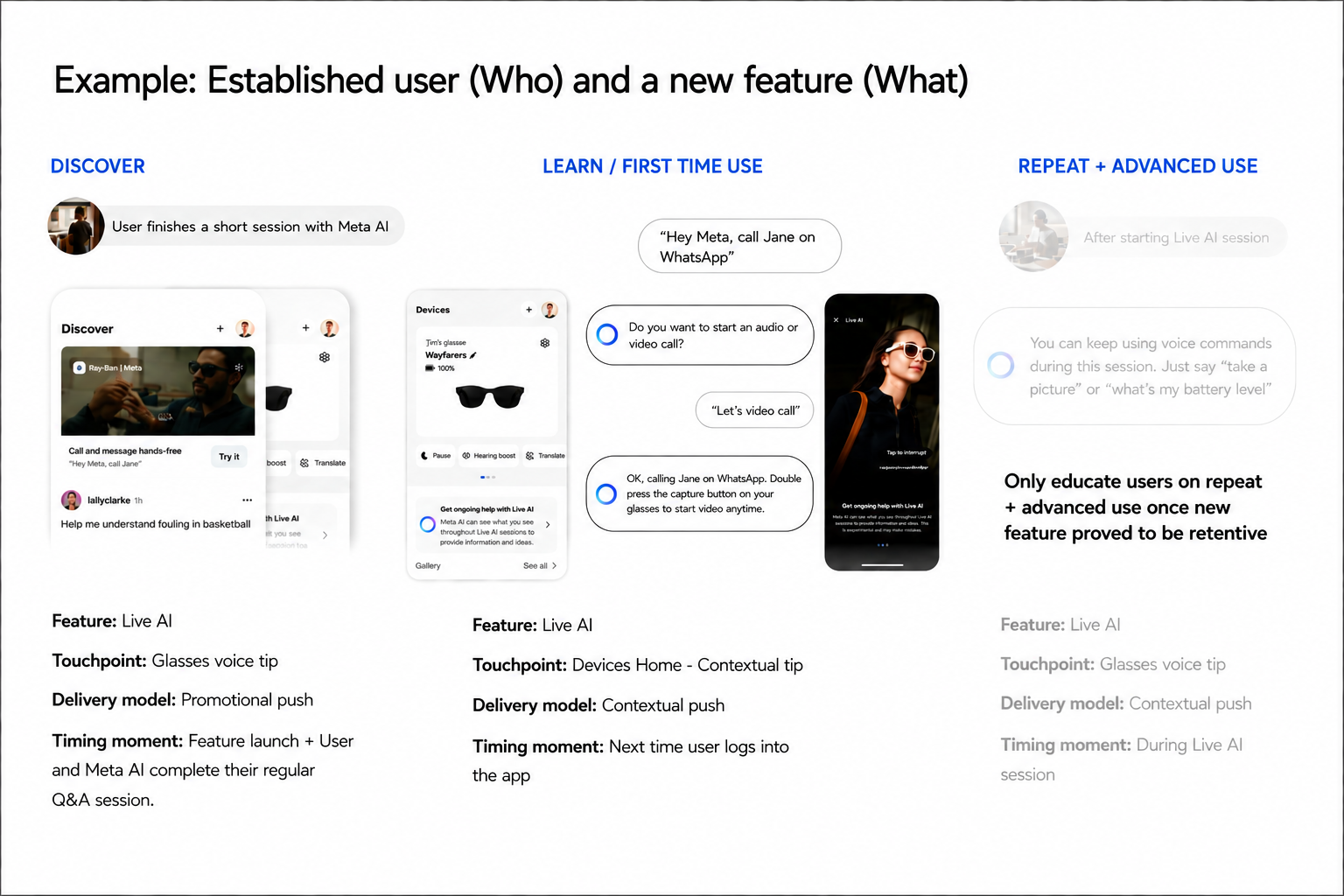
Unique users need specific guidance, so I created a strategic model based on audience, subject matter, delivery surface, and context.
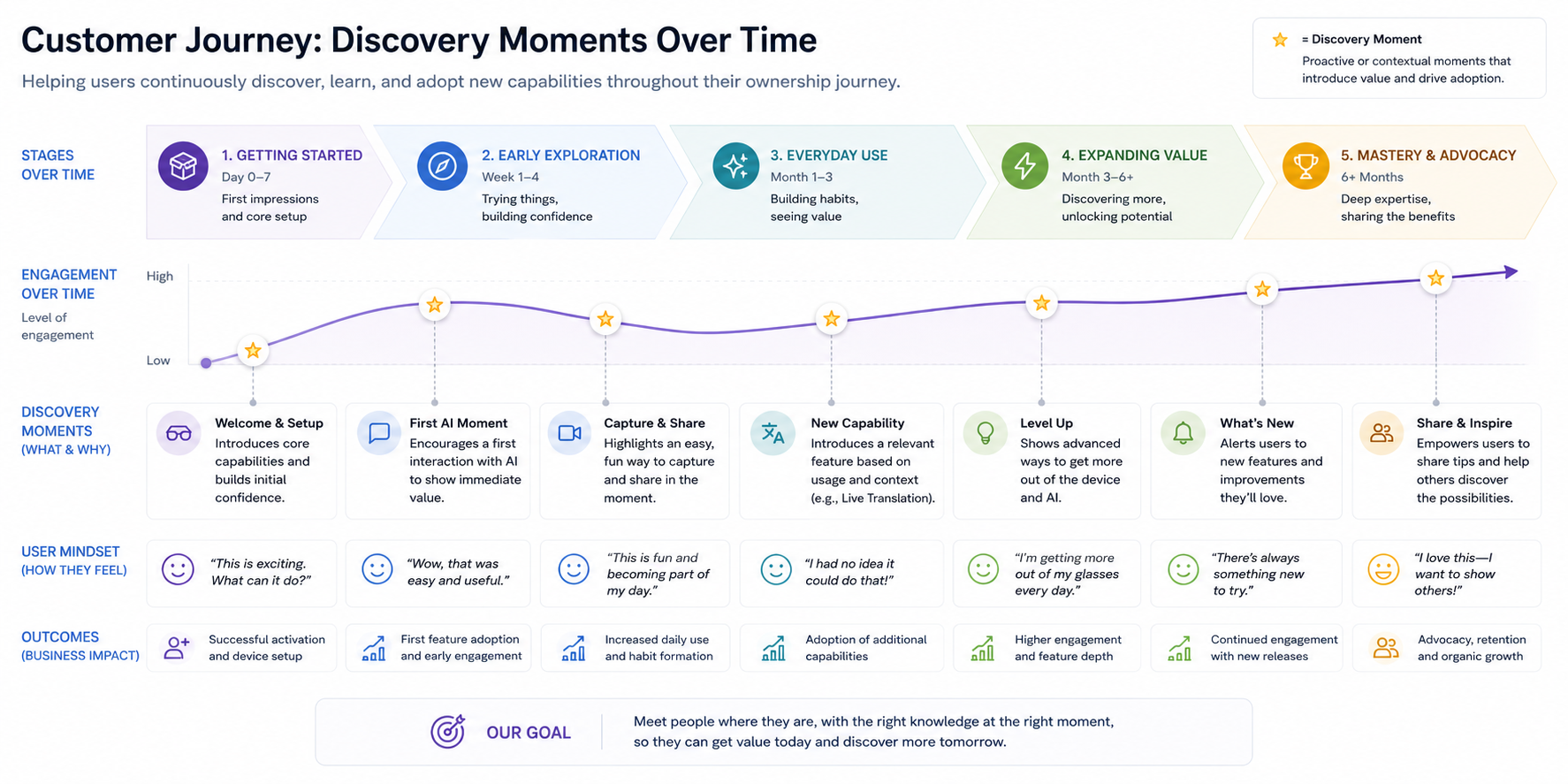
Applying the framework
Organizational impact
Aligned teams around a shared approach to discovery and education
Teams work very hard on features they create, and they want to get them out there in front of users. But not every feature can be discovered and learned about at once, nor should it. This strategy eliminated a lot of time spent in meetings trying to figure out how and when users see discovery and education content.
Created a scalable foundation for future feature launches
In addition to creating a new framework, the team also created a wiki to guide partners through each part of the education and discovery funnel, from intake to implementation, which created a self-service culture that gave greater ownership to feature teams.
Shifted conversations from isolated UI improvements to lifecycle learning
Designing this strategy with alignment from necessary partners meant that in the future we’d have fewer conversations about small tweaks that could be made to potentially move the needle on a given metric. Our framework let us stay focused on established goals while leaving room for experimentation along the way to gain additional insights in a deliberate, strategic way.
What I learned
Designing this strategy taught me what happens when you focus on the forest and not the trees. Working in a company like Meta where there are many teams working on many features, it’s easy to get myopic and look at every challenge like a unique problem to be solved. But by recognizing commonality, you uncover opportunities to implement systems that simply make sense for the user and the business. And once that happens, you can begin to deliver real value.